You don’t test a narcissist by confronting them. And you don’t ask them to go to therapy because they will never. Instead, use subtle, low-stakes experiments that show you their true character.
Here are 6 free narcissist tests that can help you to look past the charm and see the reality.
1. The money test
Narcissists have toxic habits with money. If you want to quickly figure out whether someone might be a narcissist, watch for these financial behaviors:
They spend on bling
You will notice them spending on status items they can’t afford, like designer goods, luxury brands, and the latest gadgets, while neglecting or complaining about essentials like food, health, or basic household needs.
The test: Mention a basic expense (rent, groceries, medical bill), then a luxury (a trip, a designer item). If the essentials feel like a heavy burden to them, but luxuries are easily justified, their spending is likely driven by image, not needs.
They dig into your income and assets
Early in the relationship, they may quickly probe your income, savings, or earning potential. This is done under the guise of “planning for the future” or “being transparent.”
If they detect you’re financially secure, they may suddenly suggest joint projects or emphasize their financial struggles, subtly pressing you into the role of rescuer.
They also borrow money from you, take a long time to pay it back, and then spend freely in front of you as if they don’t still owe you. As time passes, the unpaid debt becomes something you’re expected to stop mentioning.
The test: Act like you’ve lost a source of funding. Or, you can say you got a new position that requires more of your time but pays less. Watch their reaction. Do they lose interest, become less supportive, or suddenly make you feel like a burden?
They react explosively when you set limits
A healthy partner will respect your limits without taking them personally. A narcissist, however, will interpret your boundary as a threat to their control.
When you say “no,” watch how they reframe it. They may cast your boundary as distrust, pressuring you to give in to prove loyalty. This reveals more about their character than your refusal.
The test: Calmly decline a request to cover any expenses. A simple, “I prefer to split expenses evenly,” is all it takes. Watch for guilt-tripping, name-calling, or victim narratives.
They are secretive about their finances
Despite their interest in your finances, they are extremely secretive about their own. They will deflect questions about their income, debts, or savings with vague answers or by changing the subject. They may also position themselves as the one who “handles the boring money stuff,” especially in business or shared living situations, to maintain control over information.
The test: Create a situation that requires financial transparency. In a business context, insist on seeing books or budgets before committing. In a personal context, propose a shared expense where both parties must contribute openly. If they deflect, obscure, become defensive, or try to gaslight you for asking, they value control over partnership.
They show generosity in public but are tight-fisted in private
They may appear generous in front of others, covering dinners or giving visible gifts, while being tight-fisted or transactional in private. The public generosity serves image management.
The test: Simply compare their public performance with their private behavior. Does the person who flashes cash at a restaurant suddenly have no money to pay their share of the bills at home?
They use money as a reward-and-punishment system
Finally, be aware that money can become a reward-and-punishment system in their hands.
When you comply with their wishes, they may fund luxuries or fun experiences. But when you assert boundaries or displease them, they may withdraw financial support or refuse to cover necessary expenses. Bit by bit, this can pressure you into playing along just to keep daily life or a business functioning.
The test: Notice what happens when you set a small, reasonable boundary, like “I’ll cover my share only.” A healthy partner respects. A narcissistic response with guilt, sulking, or sudden “scarcity narratives” to make you responsible for their financial well-being.
2. The impulse test
A narcissist can’t wait long to get what they want.
For example, if they give you something, a gift, a favor, or even unsolicited advice, it’s done to create an obligation. And they will come back to collect as soon as possible.
If you don’t reciprocate on their timeline, they escalate. They may resort to toxic tactics like the silent treatment, guilt-tripping, or making snide comments about how they “always give and get nothing back.”
So, what can you do to test this pattern without escalating conflict?
Simply, accept their gesture or gift warmly, say thank you, and wait. Do not offer anything in return immediately, and do not explain why you aren’t reciprocating.
Then, observe what happens next. A generous person gives freely, with no strings attached. They won’t keep a register.
But a narcissist will reveal themselves within days, sometimes hours. They will hint at what they expect, remind you of what they did, or become cold and distant when their “investment” doesn’t yield an instant return.
3. The crisis test
Narcissists aren’t willing to sit with your pain. Your crisis creates two problems for them: it redirects attention away from them, and it demands resources (emotional, financial, or practical) that they prefer to reserve for themselves.
So when you’re in crisis, they don’t support you. They withdraw, minimize, or even exploit the situation to protect their position.
Try this subtly:
Act like you’re having a hard time, but don’t exaggerate or get dramatic. Bring up an unexpected expense, mention that work is complicated, or let them see that you’re tired, stretched, or unsure.
Then just watch how they respond.
You will see their reality.
Some will disappear entirely, text going quiet when you need them most. Others will offer performative concern, a single “that’s rough” before spinning back to themselves.
Many will turn your struggle into competition, countering every difficulty you name with a worse story of their own, erasing your experience. A few may even weaponize your vulnerability, storing it away to use against you later when they need leverage.
Remember: a healthy person offers steady presence without fixing, listens without competing, and supports without keeping score.
4. The reality test
Narcissists live in a world they design. One where they are always right, central, and justified. In their narrative, they are the competent one, the generous one, the victim, or the hero, depending on what serves them at the moment.
And this self-concept requires constant reinforcement from everyone around them (you).
So, the reality test is simple:
Gently introduce information that contradicts their preferred story.
Show them something they did instead of what they claim to have done. Hold up a mirror to the gap between their self-image and their behavior.
If they claim they always have your back, mention a moment they didn’t. If they position themselves as the logical, level-headed one, gently note a time they overreacted.
Notice how they respond. Many narcissists will:
- Deny or minimize
- Shift blame
- Gaslight
- Turn it into an attack
A healthy person, by contrast, acknowledges the mistake, accepts responsibility, and may even take steps to correct it.
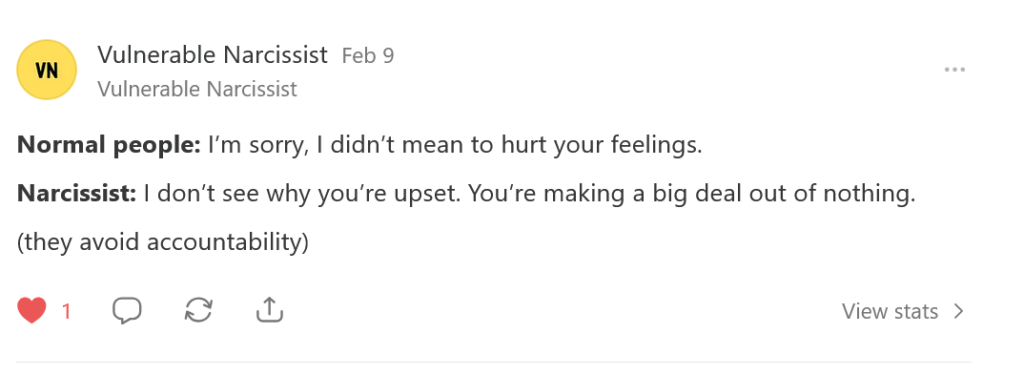
Here’s an example of the difference between a healthy person and a narcissist when you confront them about hurting you.
5. The self-growth test
This test shows how a narcissist reacts when you make changes that improve your life, confidence, or independence. It could be anything from returning to the gym, expanding your social circle, pursuing a new hobby, or simply enhancing your appearance. Anything that redirects energy back to yourself.
This self-growth threatens the narcissist because it changes the power balance. As you grow, you rely less on their validation, find joy elsewhere, and start seeing your worth reflected in other places. Your world gets bigger, and when your options expand, you become much harder to control.
So, you might notice them:
- Minimize your achievements
- Jealousy and competition
- Criticism disguised as concern
- Withdrawal or passive-aggression
- Attempts to sabotage
Sometimes self-growth doesn’t just expose the narcissist. It ends the relationship. As you expand, you no longer fit inside the narrow role they needed you to stay in.
A partner who loves you will celebrate your glow. They might miss you, sure, but they’ll adjust. They’ll notice your confidence and appreciate it.
6. Finally, trigger as many signs as you can
Some narcissists are highly convincing. They’re successful, attractive, and accomplished, and they’ve learned to perform empathy so well that even close friends may not notice what operates beneath the surface.
This becomes especially risky when you hold less social power, money, or status. From that position, their confidence, and comfort in the world can easily be mistaken for genuine character rather than careful self-presentation.
In these cases, education is your greatest free narcissist test.
Learn as many signs of narcissism as you can, including those that initially appear positive, and observe interactions with intention.
Learn as many signs of narcissism as you can. Then try to gently test for the signs. Create low-stakes situations that might typically trigger a narcissistic response.
Your aim is not provocation or confrontation, but information gathering.





Pingback: Yes and No: Can a Narcissist Be a Good Person - Vulnerable Narcissist
Pingback: How to Survive Living With a Narcissist? - Vulnerable Narcissist
Pingback: 10 Signs You Are an Adult Child of Emotionally Immature Parents - Vulnerable Narcissist