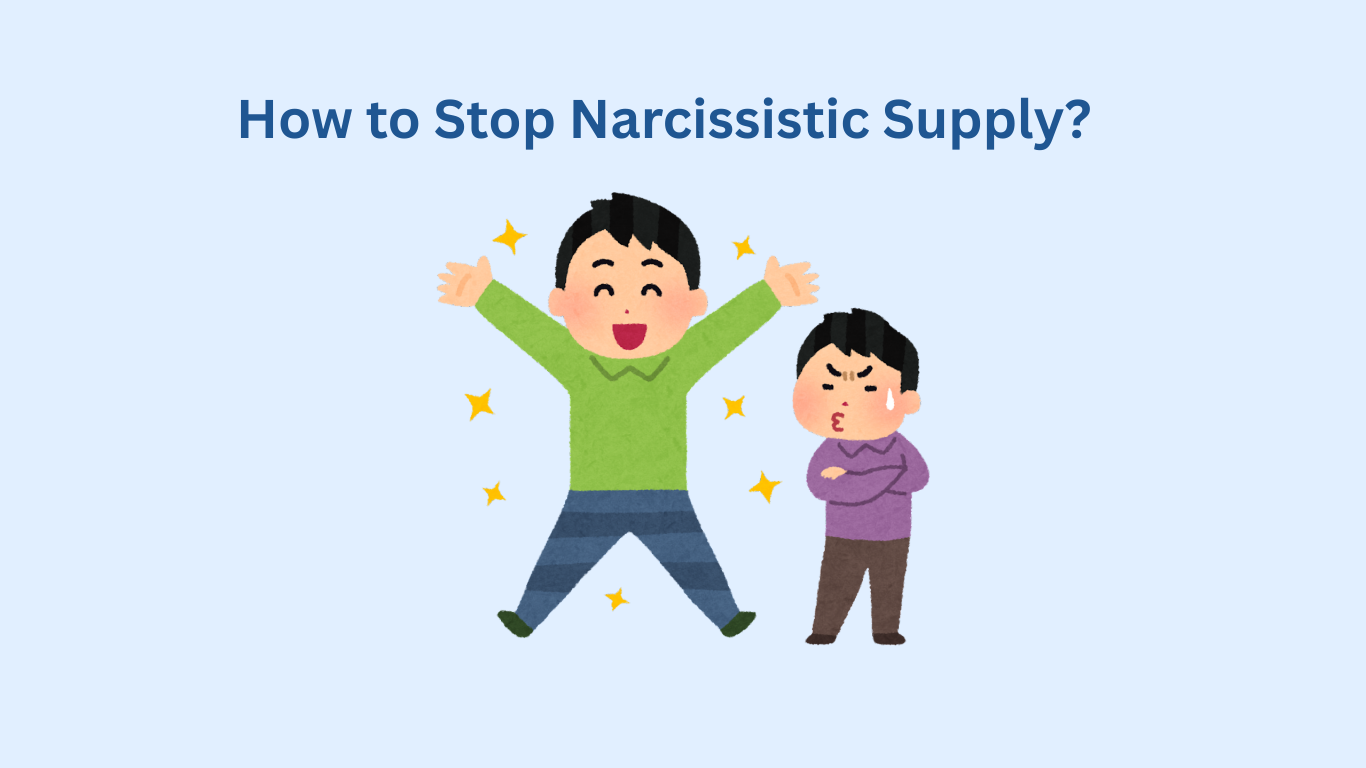
Narcissists crave your praise and reactions to feel important. To get that fix, they pull you into cycles of drama, guilt, and manipulation to provoke a response. Every emotional response you give validates their superiority.
This energy is called narcissistic supply, and as long as you are providing it, the toxic cycle will continue.
However, when you learn to stop narcissistic supply, you break the cycle and take control of the relationship.
In this guide, we’ll show you 3 steps to stop providing narcissistic supply and take back your peace of mind.
What is narcissistic supply?
Narcissistic supply refers to the attention, admiration, validation, or emotional reactions a narcissistic person depends on to feel worthy.
It can be positive, such as:
- Compliments and praise for achievements, status, or appearance
- Winning awards or receiving public recognition
- Being the center of attention at social events
- Association with famous or high-status individuals
- Social media likes, followers, and visible admiration
It can also be negative, including:
- Conflict, fear, guilt, or emotional dependency
- Provoking arguments or intense emotional reactions
- Making others angry, upset, or cry
- Being feared or causing dramatic scenes
- Trolling, breaking rules, or acting cruelly to provoke a response
In both cases, the reaction itself is what counts. It signals that they have impact, relevance, or control.
When this supply is steady, they appear confident or grandiose. When it is threatened or withdrawn, they may become defensive, manipulative, withdrawn, or escalate their behavior to recapture attention.
How narcissists seek supply (the cycle)
The pursuit of narcissistic supply follows a predictable cycle in relationships:
- Idealization (love bombing): At first, the narcissist showers attention, flattery, and affection, putting the target on a pedestal to secure them as a source of supply.
- Devaluation (supply phase): Once the target is invested, the narcissist subtly criticizes, controls, and undermines them. The target’s confusion and attempts to “win back” the narcissist’s affection are the ongoing supply.
- Discard (source runs dry): When the target stops providing reactions (becomes depressed) or sets boundaries, the narcissist withdraws or ends the relationship, moving on to a new source to restart the cycle.
If you successfully cut off a narcissist’s supply, they may experience what’s called a narcissistic injury or narcissistic collapse. This is a period of shame, emptiness, and anger triggered by the loss of control and validation.
Here are 3 steps to stop providing narcissistic supply
The narcissist’s power depends entirely on your reaction. Without it, they have nothing. Here are 3 steps to stop providing narcissistic supply and take control of the relationship.
1. Cutting off information channels
Narcissists need information to know which buttons to push. Every piece of information you put out into the world, whether directly to them or on a public channel, is data they can use. This includes your feelings, plans, achievements, struggles, and online activity.
To protect yourself, you must limit what they can see or access. This strategy works on several levels:
- First, it prevents them from using your experiences as material for validation, competition, or criticism. If they can’t see you having fun without them, they can’t devalue you for it.
- Second, it disrupts their feedback loop. Without visible reactions or personal disclosures, they have fewer cues to manipulate or exploit.
- Third, it weakens their position, because they can no longer track how much space they occupy in your life.
Here’s how to do it in practice:
- Stop sharing personal updates (plans, successes, or struggles)
- Adjust your social media visibility. Lock down your profiles and be aware of what you post
- Be mindful of shared friends, family members, or colleagues who may convey your updates
- Be boring and avoid reacting. When interaction is unavoidable, give short, uninteresting responses and show no emotion.
When you first starve a narcissist of information, they will panic and dramatically increase their efforts to get a reaction.
They may bombard you with calls, texts, and emails. They may also contact your friends and family. Furthermore, they may send cruel messages or, conversely, pretend to be caring and concerned to entice you back in. If that doesn’t work, they may show up at your home or workplace.
However, you must hold firm and give them nothing.
2. Master the Grey Rock technique
The main idea of Grey Rock is to become the most uninteresting, boring, and unresponsive version of yourself when contact is unavoidable. This means changing your mindset, communication, and availability.
To do this, you must stick to logistical, non-emotional topics, using only brief replies like “yes,” “no,” or “I see,” “OK,” while avoiding any questions about their life or sharing details about your day, plans, or feelings.
This verbal lack of interest must be paired with a monotone voice and a neutral face, never reacting to insults or attempts to defend yourself.
You must also break the habit of instant availability by waiting hours or days to respond to calls and texts. Make sure you mute notifications so you only engage when you are calm enough to remain dull.
As mentioned before, go completely private or stop posting on social media. If they push, simply repeat your boring, boundary-based tactics.
3. Control the narrative with flying monkeys
Flying monkeys are intermediaries the narcissist uses to get information, provoke guilt, or manipulate your actions. They can be friends, family, coworkers, or even neighbors.
These individuals serve as extensions of the narcissist, who feeds off the drama or influence they help create.
Therefore, to cut off the narcissist’s supply, you must proactively control the narrative.
Refuse to engage in triangulation and present a unified, boring front. Your only response to their probing should be a vague, uninterested variation of the Grey Rock method. Avoid being defensive, emotional, or reactive.
Conclusion
Remember this: Your attention is a privilege. And when you revoke that privilege, you are delivering the most devastating punishment a narcissist can ever receive.
Every time you refuse to react, you are delivering a message: “You do not matter to me, and you have no power over me.”
That message triggers their deepest insecurities like their fear of being ordinary, irrelevant, and powerless. It forces them to sit with the emptiness they spend their entire lives running from.
Yes, they will fight back. But that resistance is a sign that you are succeeding.






Pingback: Why Getting Revenge on a Narcissist Is a Bad Idea (7 Reasons)
Pingback: What Happens When You Catch a Narcissist Cheating? (Most People Don’t Realize #7)
Pingback: 13 Vulnerable Narcissist Traits That Are Easy to Miss
Pingback: Why Do Narcissists Cheat With Nasty Women When They Have a Good Woman? (11 Validating Reasons)