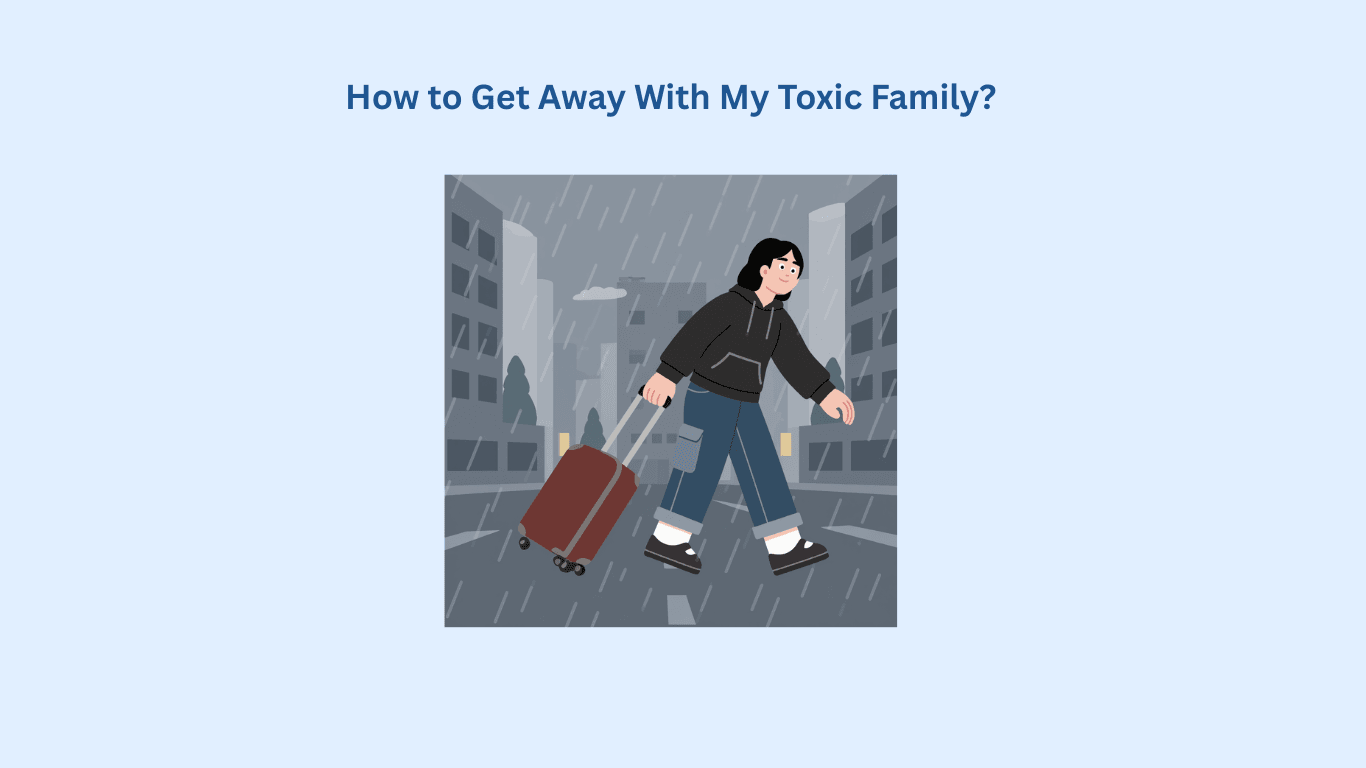
The question, “How to get away with my toxic family?” rarely has a single dramatic answer.
In most cases, freedom does not come from one decisive moment or a symbolic walk out the front door. It is built through dozens of small decisions made over time.
This guide provides a practical outline for creating both emotional and practical distance from a toxic family system, even when circumstances require you to remain in contact.
1. Reduce engagement in arguments that go nowhere
Toxic families thrive on circular arguments. These are the fights that have no beginning, no end, and no resolution. They start with a dirty dish and escalate into a consultation on your entire life choices.
To disengage, you must learn the art of the non-response.
When a relative tries to bait you into a fight about politics, your career, or why you didn’t call your aunt back, do not explain, defend, or justify.
Explanations are weapons in toxic families. The more you explain, the more they have to use.
Instead, use neutral, boring phrases delivered in a monotone voice: “You might be right.” “Interesting.” “I’ll think about that.” “Hmm.” These are called “gray rock” responses.
When the argument escalates, physically leave the room. Go to the bathroom or look at your phone.
2. Refuse to be the family referee or peacekeeper
Many people from toxic families are assigned a role. They become the mediator, the problem-solver, or the emotional caretaker responsible for keeping everyone happy.
You may feel pressured to settle disputes between relatives, listen to endless complaints, relay messages between family members, or absorb everyone’s emotional burdens.
To refuse this role, you need a script: “I love you both, but I’m not going to get in the middle of this.” Then, hang up the phone or walk away. Repeat it like a broken record.
The first few times you refuse to referee, the family will be upset. They will call you selfish. And that is a sign it is working. They are panicking because they have lost their unpaid emotional laborer.
3. Do not share any news
We all want our families to celebrate us, but in a toxic family, information is a weapon.
Every detail you share (a promotion, a new relationship, a health scare, a financial windfall) will be weaponized against you.
Good news will be minimized (“Oh, that’s nice, but your cousin just became a doctor”). Bad news will be gossiped about (“Did you hear she’s in therapy? Shameful”). Neutral news will be twisted (“You’re moving to a new apartment? Why can’t you ever stay put?”).
So, when they ask, “How is work?” you say, “Busy.” When they ask about your love life, you say, “Nothing new.” When they ask about your finances, you say, “Same as always.”
Feed them only the bland, the boring, the unremarkable. That’s how you stop handing them the knife.
4. Focus on building your future rather than reforming your family
You cannot fix them.
Most adult children of toxic families spend decades in a fantasy loop: “If I just get a better job, they’ll respect me.” “If I just have a baby, they’ll soften.” “If I just go to therapy, I’ll learn how to make them love me properly.”
None of that works.
You cannot reform your mother’s narcissism with the right combination of love and boundaries. You cannot convince your father to stop being verbally abusive if you just find the right words. Likewise, you cannot hold a family intervention that turns your volatile sibling into a reasonable person.
The only person you can change is you.
Focus on building your future.
Invest in education, career development, healthy friendships, personal goals, financial stability, and mental and physical health.
Not to win their approval, but to build a life that no longer needs it.
5. Become less reactive
Toxic people feed on reactions. They poke and prod you until they get a flinch, a tear, a scream, or a slammed door.
That reaction is their reward. It proves to them that they still have power over you. And your best defense is simply to starve them of it.
Try these techniques:
- Pause before you reply
- Speak slowly and evenly
- Keep responses brief
- Resist the urge to over-explain
- Leave the moment a conversation turns hostile
The less emotionally reactive you become, the harder it is for anyone to manipulate you.
6. Spend more time in healthy environments
One overlooked answer to the question of how to get away with my toxic family is spending more time in environments where respect, kindness, and healthy communication are the norm.
If you spend 20 hours a week in a healthy, respectful environment, you begin to understand that you are not the problem. The environment is.
To create that distance, start with physical absence. Get a library card, a gym membership, a job that requires evening shifts, or a coffee shop where you’re a regular. Find any excuse to be out of the house.
Beyond physical absence, you also need emotional replacement environments. Places where people are kind without an agenda.
That might be a book club, a hiking group, a meditation center, a volunteer organization, or a church (if that’s your thing). It might simply be a friend’s living room where the conversation never involves emotional blackmail.
7. Work toward financial independence
As long as you require their money for rent, tuition, a car, or a phone bill, they have leverage. And toxic families love leverage.
Financial independence changes everything. The more capable you are of supporting yourself, the more freedom you have to set boundaries, make your choices, and walk away when necessary.
So, learn skills that increase your earning potential. Pursue education, training, or certifications that improve your career prospects.
Furthermore, build an emergency fund, even if you can only save a small amount at a time. Reduce unnecessary debt, seek stable employment, and develop a long-term financial plan that supports your goals.
At the same time, protect your financial privacy. Not everyone needs to know how much you earn, how much you’ve saved, or what your plans are.
If you’re currently dependent on your family, focus on a realistic exit strategy. Independence rarely happens overnight. Create a timeline with measurable goals. For example:
- In 12 months: I will have my emergency fund.
- In 18 months: I will pay my phone bill and personal expenses.
- In 2 years: I will move into my place.
- In 3 years: I will be completely self-sufficient.
Get away financially, and the rest becomes exponentially easier.
8. Set boundaries about topics, behavior, or access to your time
A boundary is a promise you make to yourself about what you will and will not accept in your life.
Examples of boundaries include:
- Refusing to discuss certain topics
- Limiting phone calls
- Leaving conversations that become abusive
- Declining invitations when necessary
- Restricting access to personal information
- Spending less time with certain individuals
Remember: Their discomfort is not your failure. It’s the natural result of a condition that you are finally correcting.
9. Keep records of important incidents if there is emotional, financial, or physical abuse
Documentation serves several purposes.
First, it helps counter self-doubt. Toxic individuals deny events, rewrite history, or claim incidents never occurred. Having records helps you maintain clarity.
Second, documentation may become critical if professional assistance, legal support, housing services, workplace accommodations, or protective measures are ever needed.
Depending on your circumstances, this may include:
- Dates and times of incidents
- Written communications (emails, texts, letters)
- Financial records
- Screenshots
- Witness information
- Detailed notes about events
Store all records securely. If you are facing serious abuse, seek assistance from qualified professionals, legal resources, or support organizations, and prioritize your safety above all else.
Most people never need to use these records in court. But just having them changes the power balance.
Conclusion
So, how to get away with my toxic family>
Creating distance from a toxic family is painful. It involves grief, guilt, and difficult decisions. But protecting your well-being is necessary.
You deserve relationships built on respect, trust, and genuine care. Whether your path involves stronger boundaries, limited contact, or complete separation, each step toward a healthier life is a step worth taking.
One day, you will wake up and realize: you have already left.
So start small. Pick one idea from these nine. Just one. Practice it for a week. Then another. Then another until you get free.