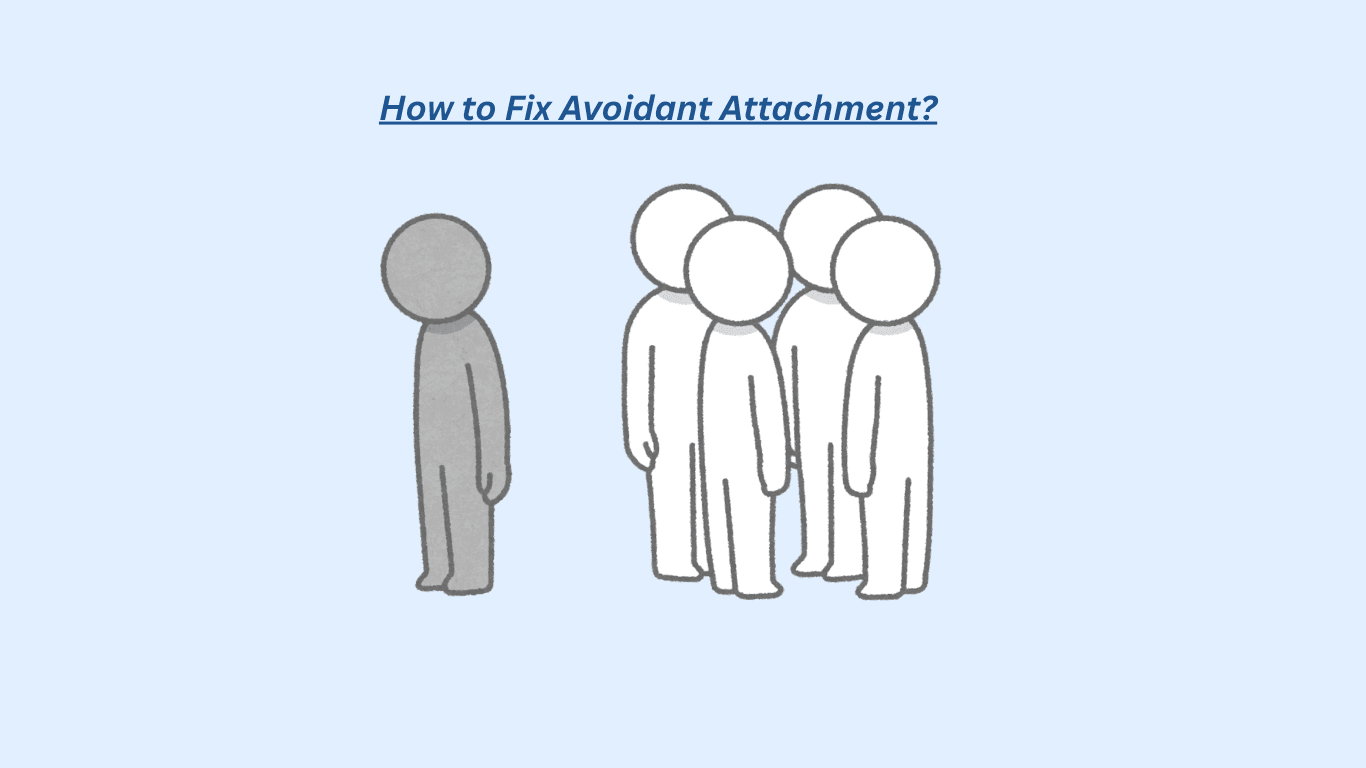
How to fix avoidant attachment is a question many people ask when they realize their fear of emotional closeness is affecting their relationships.
Avoidant attachment is a learned survival strategy. It’s a set of beliefs and behaviors developed in childhood to maintain emotional distance as a form of self-protection.
These adaptations persist into adulthood, leading people with an avoidant attachment style to prioritize independence, suppress emotional expression, withdraw during conflict, and avoid relying on others or allowing others to rely on them.
However, these practices can be changed. Fixing them requires conscious effort, discomfort, and a systematic rewiring of your responses to connection.
So, if you are ready to stop pushing people away, this guide shows you how to fix avoidant attachment.
1. Practice naming your emotions
Avoidant individuals experience emotional numbing. You may know you are feeling “bad” or “off,” but you cannot specify what the feeling is. You call it stress or tiredness instead of anxious, disappointed, lonely, scared, or invalidated.
Fixing this starts with building an emotional vocabulary.
Do not say you are “fine.” Fine is not an emotion. When you feel a change in your body or mood, stop and label it. Assign a specific word to the feeling. And if you feel nothing, name that too. Saying “I feel numb” is a valid emotional state.
The act of naming moves the emotion from the subconscious to the conscious mind. This breaks the automatic habit of shutting down.
2. Become comfortable with vulnerability
Avoidant individuals view vulnerability as a weakness. They see sharing emotions, asking for help, or admitting fears as uncomfortable because it creates emotional exposure.
To fix this, you need to rewire your brain to see vulnerability as courage.
You do not need to reveal everything at once. Start small.
Share a minor insecurity with a friend, admit when you do not know something at work, ask for directions, and reveal that you are struggling with a task.
The goal is to prove to yourself that the world doesn’t end when you expose a flaw. It is one of the main ways trust develops between people.
3. Express your needs openly
People with avoidant attachment suffer in silence. They assume they should handle everything alone. And they expect others to figure out what they need without asking.
This is difficult because you fear rejection. You fear that if you ask, you will be denied, confirming that you are not worth supporting.
And the only way to disprove the fear is to test it. Ask for small things daily. If the other person says no, respect it. You will survive. And if they say yes, you have just built a bridge toward interdependence.
4. Replace avoidance with curiosity
When conflict or emotional discomfort arises, avoidant individuals tend to withdraw. They may change the subject, leave the room, stop replying to messages, or emotionally shut down.
To fix this, replace the avoidance mechanism with curiosity.
Curiosity forces you to stay in the room. It redirects your focus from self-protection to understanding the other person. It destroys the defensive wall you have erected.
So, when your partner says something that triggers a desire to flee, stop yourself. Instead of leaving, ask a question. “Why do you feel that way?” “What happened to make you think that?” “Can you tell me more?”
It takes practice, but every time you choose curiosity over avoidance, you strengthen the neural pathway for connection.
5. Practice accepting support from others
The idea of relying on someone else feels like a trap. And accepting support is a direct threat to your independent identity. But that belief is what keeps you isolated.
The solution is to start accepting support actively without feeling guilty, indebted, or weak.
If someone offers to make you a cup of coffee, say yes. If someone offers advice, listen and try it before you dismiss it. And if someone offers a ride, take it.
The point is to tolerate the discomfort of receiving.
However, make sure you don’t insist on returning the favor immediately. Just receive and let the debt sit.
6. Stop assuming independence is a strength
Hyper-independence is a trauma response avoidants develop to protect themselves from the disappointment of others.
Realize what your hyper-independence has cost you.
Write down the relationships you have lost, the opportunities for connection you have missed, or the burnout you have experienced. Acknowledge that “doing it alone” has taken more from you than it has given.
Real interdependence is the ability to stay connected to others while maintaining your sense of self.
When you feel the urge to be the “lone wolf,” remind yourself that wolves travel in packs. Strength is not found in isolation but in knowing when to lean on others without losing who you are.
7. Challenge negative beliefs about relationships
Understanding how to fix avoidant attachment requires changing long-standing beliefs about intimacy.
Your avoidant internal operating system contains toxic beliefs such as:
- People always disappoint me.
- I cannot trust anyone.
- Relationships take away my freedom.
- Getting close always leads to pain.
- Depending on others is dangerous.
These beliefs may feel true, but they are hypotheses based on experiences, and they are inaccurate in the present.
To fix this, you need to actively debate these thoughts.
Write down the belief. Then, write down three counter-examples from your current relationship or friendships.
Look at the behavior of the person in front of you, not the ghost of the person who hurt you. This is a cognitive behavioral exercise. It takes effort, but it rewires the automatic negative thoughts that trigger your avoidance.
8. Practice active listening
Avoidant attachment can sometimes lead people to mentally check out during emotional conversations.
Active listening helps you stay engaged. It redirects your focus to understanding instead of preparing your response.
When someone is speaking, your only job is to listen and reflect. Don’t formulate your response while they are talking. And don’t wait for the moment to explain why you are right or why their complaint is valid/invalid.
Wait until they are done.
Then, paraphrase what they said. “What I am hearing is that you felt ignored when I left the room. Is that right?”
This validates their experience without you having to agree with it. It slows down the conversation. It prevents you from becoming defensive. And it forces you to stay engaged with their reality rather than retreating into your head.
9. Stop expecting rejection
People with avoidant attachment assume relationships will end or become painful. This expectation can lead them to pull away before someone has the chance to hurt them.
To stop this, you need to reset expectations. When you wake up, tell yourself that the people in your life are for you, not against you. When you are about to have a difficult conversation, don’t assume it will end in disaster.
Think of the best possible outcome. Imagine them reacting positively. This makes you more approachable and makes the other person less likely to reject you.
10. Take small emotional risks
Building secure attachment requires practice.
However, you don’t have to make dramatic changes overnight. Instead, take manageable emotional risks.
In your relationship, take a small risk. For example:
- Initiate a conversation about your day that is deeper than “it was fine.”
- Tell someone you appreciate them without being prompted
- Offer a hug first. Admit you are scared about something
- Share a childhood memory that is embarrassing
Each small risk has a potential reward and a potential sting. If it goes well, you receive positive reinforcement. If it goes badly, you learn that you can survive the sting.
11. Spend time reflecting after conflicts
After disagreements, avoidants usually move on as quickly as possible. This leaves the issue unresolved and creates a permanent scar.
So, commit to a new rule: After a conflict, you must reflect. Sit down, alone if necessary, and ask yourself questions.
- What triggered me?
- What emotion was motivating my reaction?
- What did I need during that conversation?
- What did my partner need?
- What could I do differently next time?
If you can stay in the aftermath of a conflict long enough to learn from it, you will not make the same mistake again. As a result, you become better at responding instead of reacting automatically.
12. Journal about your emotional experiences
For an avoidant individual, the inner life is a void you resist looking into. Journaling forces you to slow down and express that inner life.
Dedicate 5 to 15 minutes a day to writing. Write about what happened that day and how it made you feel. If you were irritated, write about the irritation. And if you were happy, write about it.
The journal serves as a mirror. As you re-read past entries, you will see habits. You will see how you default to blame, distance, or numbness. You will see the same fears coming up over and over.
And perhaps most importantly, the journal allows you to express emotions you cannot yet speak aloud. Putting words on paper builds the muscle for verbal expression later, turning a private practice into a bridge toward connection.
13. Work with a therapist familiar with attachment theory
This is non-negotiable for deep, lasting change. Some attachment behaviors are deeply rooted in childhood experiences, trauma, or long-term relationship structures.
So, finding the right therapist is an important step. Look for someone who specializes in attachment theory, Emotionally Focused Therapy (EFT), or Internal Family Systems (IFS). These approaches are designed to address early relational wounds and help create new habits of connection.
A therapist can help you:
- Understand where avoidance developed.
- Learn emotional regulation skills.
- Improve communication.
- Build trust gradually.
- Develop healthier boundaries.
- Practice vulnerability in a safe environment.
Therapy also provides an outside perspective, helping you recognize progress and changes that may be difficult to notice on your own.
14. End one relationship that reinforces avoidance (if toxic)
Some relationships validate your avoidant beliefs. They tell you “see, everyone is leaves” or “see, intimacy is dangerous.”
That’s why you need to end some relationships.
Look at your circle. Identify the person who consistently undermines you or makes you feel small. Identify the person who uses you without giving back. Then, end your relationship with them.
Ending that relationship is an act of self-respect. It proves that you are not willing to be treated poorly, just as you are trying to not treat others poorly. It also creates space for healthier dynamics to enter.
15. Reward yourself for staying present
Small, consistent incentives are enough to reshape the neural pathway from “threat” to “worth it.”
So, make a pact with yourself: every time you choose presence over avoidance, even for a moment, acknowledge it. Give yourself something to look forward to. It doesn’t have to be extravagant or expensive. For example, you might:
- Enjoy your favorite meal.
- Watch a movie.
- Take a relaxing walk.
- Buy yourself a small treat.
- Spend time on a favorite hobby.
Acknowledging and celebrating these moments helps your brain associate this new behavior with safety, satisfaction, and positive reinforcement.
Conclusion
So, how to fix avoidant attachment?
Fixing avoidant attachment requires accepting that closeness, trust, and vulnerability are compatible with independence, and they are not threats to it.
The work involves naming your emotions, expressing your needs, receiving support, questioning your assumptions, and taking risks. And the outcome depends on your willingness to choose connection repeatedly.
Do this consistently, and you rewire your attachment system.