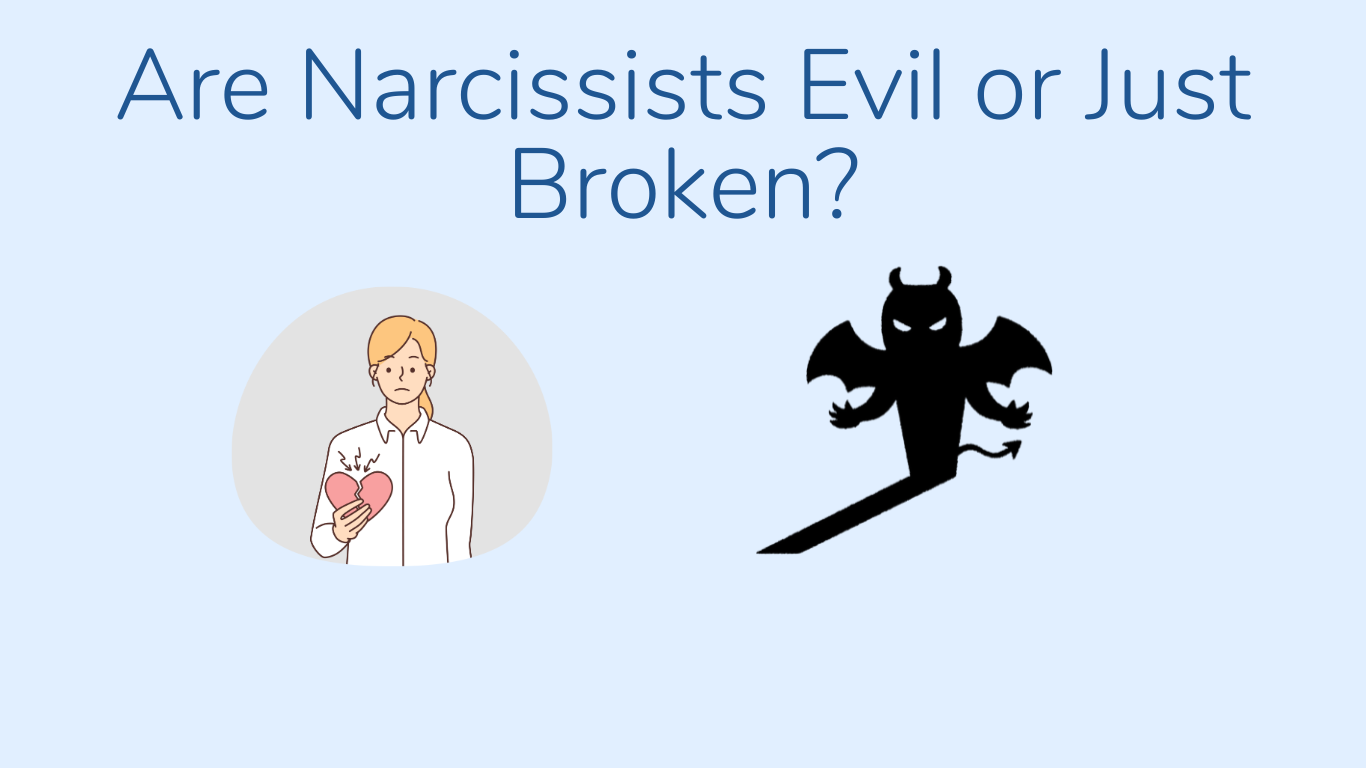
My personal answer is yes, narcissists are evil.
But that’s only one side of a much bigger conversation.
Labeling them as “evil” feels satisfying, especially if you’ve experienced the chaos they create. Yet, this either-or framing (evil or broken) oversimplifies something far more complex.
Narcissism sits at the intersection of personality, trauma, behavior, and choice. And understanding that idea matters, not to excuse them, but to make sense of the impact they have on others.
So, let’s see if we can answer the question: Are narcissists evil or broken?
The “Evil” lens: Why it’s tempting
To start, what do we even mean by evil?
Evil implies intentional malice, a conscious choice to harm others for its sake.
And narcissists certainly make that choice. They know their behavior hurts others, but they just don’t care enough to stop.
Think about it. How else do you explain someone who shows:
- The calculated manipulation
- The pleasure they seem to take in your pain
- The complete absence of guilt
- Exploits your vulnerabilities without hesitation
- Discards you cruelly when you’re no longer useful
- Never takes responsibility or shows genuine regret
That awareness without empathy feels indistinguishable from evil.
The “Broken” lens: Compassion without excuses
Psychology gives us a different way to see narcissists. At their core, many have lost the ability to connect, feel empathy, or reflect on themselves.
Their behavior flows from:
- Developmental wounds: Many grew up in environments where their emotional needs were ignored or only met if they performed or achieved. Some faced abuse or inconsistent caregiving, which made it nearly impossible to develop secure attachments.
- Neurological differences: Studies suggest that people with NPD may have less gray matter in areas tied to empathy and emotional regulation. Whether this is a cause or an effect isn’t fully clear, but it helps explain how they process emotions differently.
- Psychological imprisonment: Beneath the confidence and charm, narcissists live in constant fear (fear of exposure, of worthlessness, of the shame) they’ve buried. Their manipulative, controlling behaviors are desperate ways to avoid facing these feelings.
This framing acknowledges that narcissists are suffering too, not in ways that justify their actions, but in ways that explain them. A broken leg doesn’t make it acceptable to kick others, but it does explain a limp.
The false binary
Here’s where the either-or framing fails us: broken people can still do evil things. These aren’t mutually exclusive categories.
A person can simultaneously:
- Carry deep psychological wounds AND choose to inflict pain on others
- Lacks certain capacities for empathy AND retains moral agency in other domains
- Be a victim of their past AND be an abuser in their present
- Deserve compassion for their suffering AND be held accountable for their harm
Narcissism itself resists simple categorization. There’s a huge difference between:
- Vulnerable narcissism: insecurity, hypersensitivity, and defensive grandiosity.
- Grandiose narcissism: overt arrogance, exploitation, and aggressive self-promotion.
- Malignant narcissism: the most dangerous form, combining narcissism with antisocial traits, aggression, and sometimes even sadism.
A malignant narcissist who enjoys others’ pain exists in a very different moral territory than a vulnerable narcissist lashing out from insecurity. Both hurt people, and both are broken. But the choices they make aren’t the same.’
What this means for victims
For those hurt by narcissists, the evil-versus-broken question hides a deeper need: validation that the harm was real and that you’re not crazy.
Here’s what matters the most:
- Your pain is legitimate, regardless of the narcissist’s internal experience
- You deserved better, whether they were broken, evil, or both
- Understanding their psychology doesn’t require you to forgive or maintain contact
- They’re unlikely to change without intensive therapy. They rarely seek
- Your healing is independent of whether they ever acknowledge the harm
That’s why the “they’re just broken” framing can turn into a trap. It keeps you holding on, hoping you can fix or save someone who has to choose healing for themselves.
And…
The “they’re evil” narrative can prevent you from processing the complex reality of having loved someone capable of such harm.
So, you should ask better questions:
- Is this relationship safe and healthy for me?
- How do I protect myself while maintaining my humanity?
- Am I willing to wait and see, knowing change is unlikely?
Conclusion
Are narcissists evil or broken?
What we call them matters less than how we respond. For the victims in a relationship with narcissists, it means:
- Prioritizing your safety and well-being
- Accepting that you cannot fix them
- Grieving the relationship you wanted but never had
- Building boundaries without needing to dehumanize
The narcissist in your life is likely both suffering and causing suffering, limited by their disorder yet still responsible for their choices.
That’s not evil, and it’s not “just” broken. It’s simply the messy, painful reality of severe personality disorders.
However, your job isn’t to solve that paradox. Your job is to take care of yourself, to recognize harm as harm regardless of its source, and to build a life where you’re no longer asking this question because you’re finally, safely, free.