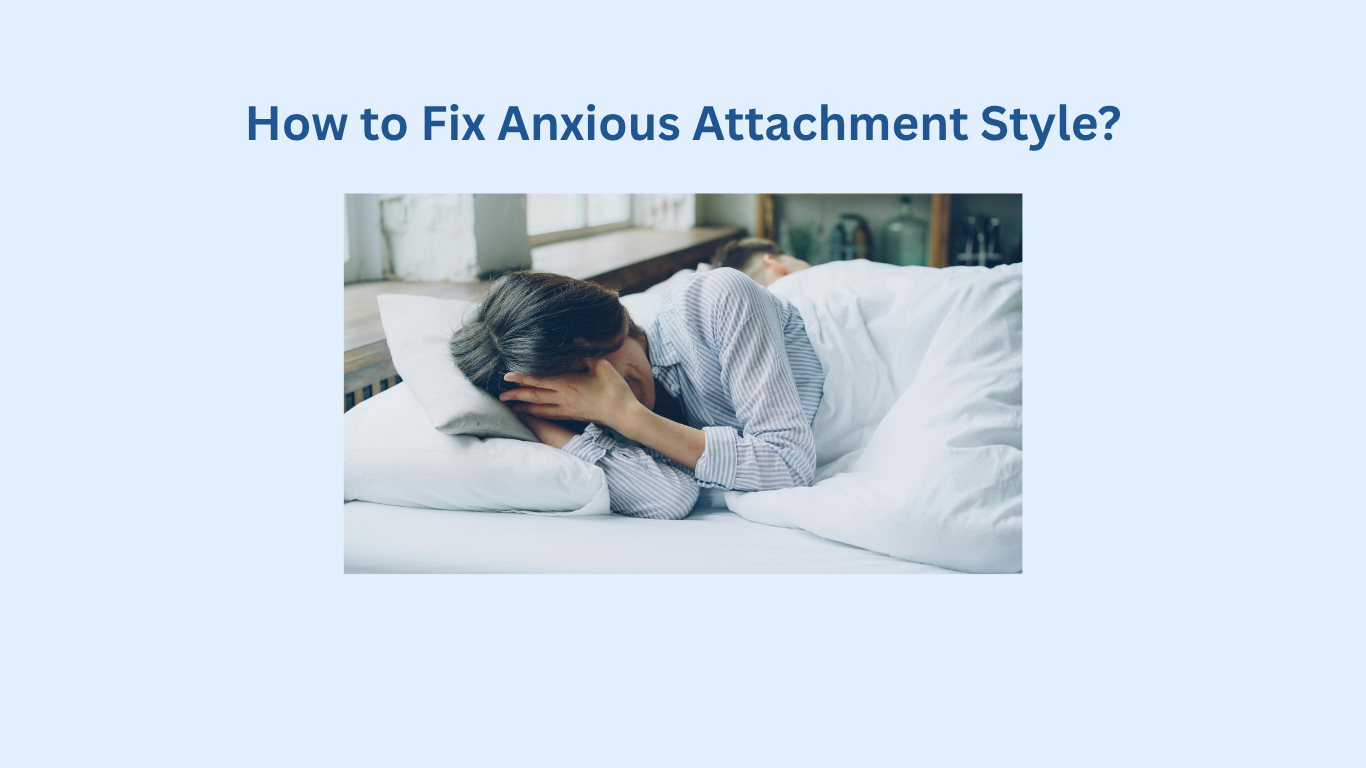
It’s time to learn how to fix anxious attachment style and create healthier, more secure relationships.
Anxious attachment can show up as hypervigilance to signs of rejection, difficulty trusting stability, and a cycle of seeking closeness in ways that sometimes push others away.
Though exhausting, these reactions are survival strategies your brain developed to keep you safe. And the good news is, you can heal.
Healing anxious attachment means learning to rewire your response to perceived threats of abandonment.
In this article, we’ll break down a 7-step approach to teach you how to fix anxious attachment style, starting with what you think, then how you react.
1. Identify your “activation” signals
Activation signals are your personal early-warning system for anxious attachment. They show up as internal cues (like a racing heart, sleeplessness, or sudden worry) or external cues (like a delayed text or a partner’s tired tone) that trigger anxiety in relationships.
Noticing these signals gives you a pause point. They allow you to step back and respond intentionally, rather than reacting automatically.
So, every time you feel a sudden spike of relationship anxiety, grab your phone or a notebook and quickly jot down:
- Time: When did it start? (e.g., 8:15 PM)
- Event: What just happened? (e.g., “He read my message 20 minutes ago and hasn’t replied”)
- Physical sensation (1–10): Rate the intensity and describe it (e.g., “8/10 – tight chest, shallow breathing”)
- The story your mind told you: Write the exact fearful thought (e.g., “He’s losing interest because I’m too needy”)
After two weeks, review your log. You’ll likely see clear patterns: the same triggers, the same physical sensations, the same fearful stories.
That awareness alone weakens their power because next time, you’ll catch the signal earlier and choose a different response.
Instead of automatically assuming rejection, you can pause, notice your feelings, and select a more secure, intentional response.
2. Dig into your roots
Anxious attachment doesn’t appear out of nowhere. It develops from early experiences of inconsistent care or emotional unavailability. Your nervous system has learned that love comes with uncertainty, so you adapted by staying hyper-alert to keep connection close.
Take time to gently explore your early attachment history. Ask yourself:
- Did I feel safe expressing needs as a child?
- Was comfort predictable when I was upset?
- Did a parent’s mood dictate the emotional temperature of the house?
You don’t need to blame or relive trauma. Just name what happened: “My mom loved me but was distracted by her own struggles.” or “I learned that asking for help led to frustration, not warmth.”
This understanding replaces self-criticism with self-compassion. From there, you can begin to rewire and re-parent your inner child.
3. Re-parent your inner child
Your inner child still holds the old fears: “If I’m not perfect, they’ll leave.” “If I speak up, I’ll be abandoned.”
Now, as an adult, you can step into the role of a calm, consistent caregiver for that part of you.
Try this: when anxiety spikes, pause and internally address your younger self. Say things like:
- “I see you’re scared. That makes sense.”
- “You’re not too much. You’re not needy.”
- “I’m here now, and I won’t abandon you.”
This internal re-parenting builds a new baseline: safety doesn’t have to come from someone else’s reassurance. It can come from you.
4. Reshape your inner dialogue
Anxious attachment runs on a loop of catastrophic predictions. Changing your inner dialogue can dramatically reduce anxiety:
- Replace “They will leave me” with “I can handle discomfort and communicate my needs.”
- Replace “I’m too needy” with “My feelings are valid and deserve attention.”
- Practice daily affirmations that reinforce safety and self-worth.
Your brain can learn new, healthier thought habits with consistent practice.
5. Build internal self-soothing skills (the core work)
This is the engine of healing. When you feel the urge to text seven times, demand reassurance, or check their social media for clues, pause. That urge is a signal that your nervous system needs regulation, not external proof of love.
So, instead of immediately seeking external reassurance, develop techniques to calm your nervous system:
- Breathing exercises: Slow, deep breathing to regulate heart rate.
- Grounding techniques: Notice your surroundings, textures, or sounds to stay present.
- Movement: Short walks, stretching, or yoga to release tension.
- Journaling: Write out fears, then deliberately rewrite them with balanced perspective.
The more comfortable you become self-soothing, the less reactive your anxious attachment triggers will be.
6. Practice leaning back
If anxious attachment has a signature move, it’s leaning in (over-texting, people-pleasing, over-explaining, or chasing reassurance).
“Leaning back” is the opposite. It means resisting the urge to over-cling or over-communicate and instead trusting that relationships can handle space.
So, the next time you feel anxious, pause and do nothing for 30 minutes.
Then, if you still feel the need to reach out, send one simple, grounded message (e.g., “Thinking of you. I hope you’re having a good day”). Don’t do any interrogation or over-disclosure.
Leaning back also means letting your partner initiate closeness sometimes. Notice if you’re always the one planning dates, starting serious talks, or repairing after a conflict.
Give them room to show up. If they don’t, that’s information, not a catastrophe. You’ll handle it either way.
7. Consider attachment-focused therapy
Self-help is powerful, but some habits are deeply embodied. An attachment-focused therapist can help you:
- Process early wounds without re-traumatizing yourself
- Practice secure behaviors in real time (with role-play or EMDR)
- Address co-occurring issues like codependency or generalized anxiety
Look for therapists trained in EFT (Emotionally Focused Therapy), IPF (Ideal Parent Figure protocol), or somatic therapies (like Somatic Experiencing).
Conclusion
Each small pause, each self-soothing breath, each moment you choose curiosity over catastrophe rewires your brain toward safety.
The old survival strategies kept you alive. Now, you get to learn how to fix anxious attachment style and teach your nervous system a new truth: You are not too much. You are not easily forgotten. And love doesn’t have to hurt to be real.
Healing anxious attachment is possible, and it begins with the simple act of noticing, pausing, and deciding a more secure path.