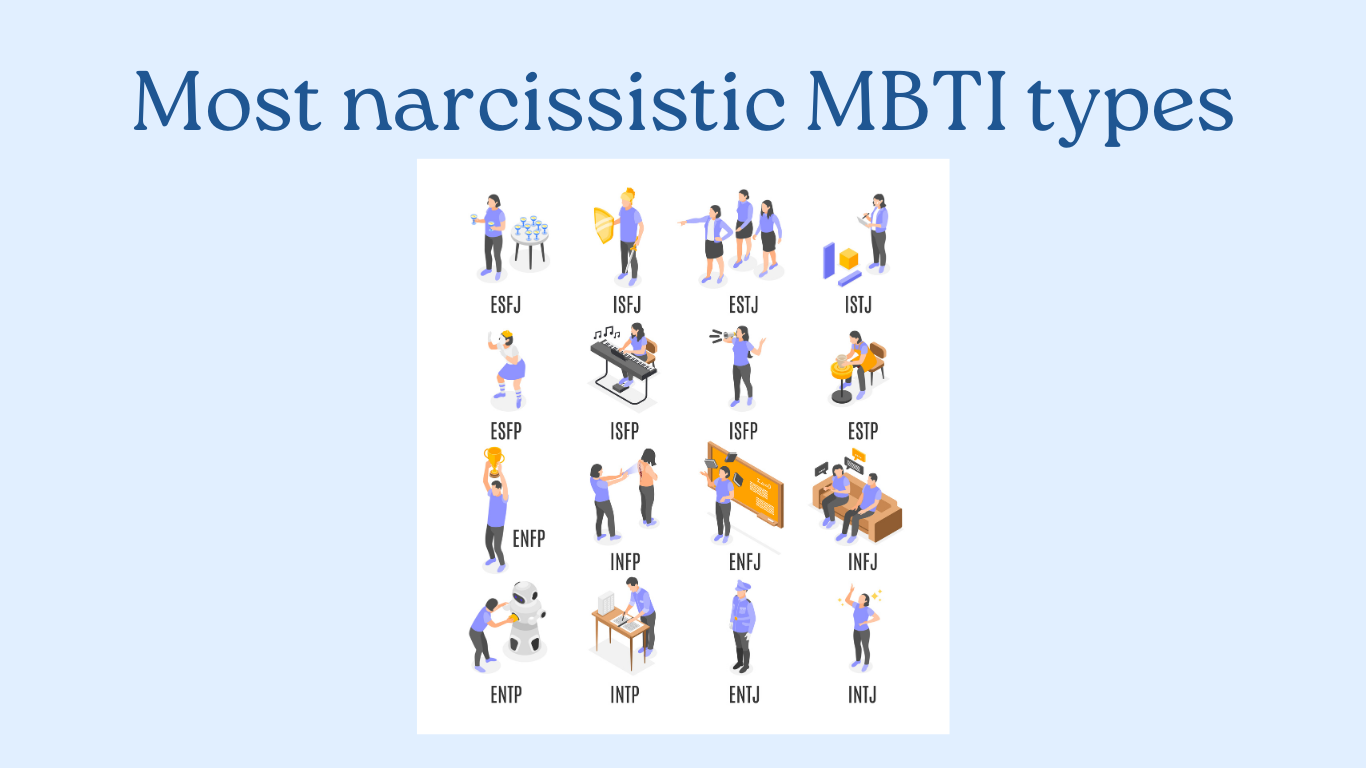
Disclaimer: This mapping of the most narcissistic MBTI types is a hypothesis, not deterministic. Individuals may shift categories over time or across different environments. The goal is to highlight potential patterns without pathologizing anyone. Any MBTI personality type can express narcissistic traits if circumstances and motivations align.
This exploration looks at how dark-narcissist behavior might appear across the 16 MBTI types, focusing on four common narcissism styles (grandiose, malignant, covert, and communal) and how each type tends to align with one of these expressions.
Ready? Let’s dive into the Narcissist MBTI.
To save your time
| Narcissism Type | MBTI Types |
| Grandiose | ESTP, ENFP, ESFP, ENTP |
| Communal | ENFJ, ESFJ, INFJ |
| Covert | ISFJ, INFP, INTP, ISTP, ISFP, ISTJ |
| Malignant | INTJ, ENTJ, ESTJ |
MBTI grandiose narcissists
Quick definition: Grandiose narcissists are the most obvious type. They’re the ones who act superior and need to be in charge. Their behavior comes across as arrogant and domineering, driven by a constant need for admiration and praise. And you’ll quickly notice they hardly show empathy.
The following are the most narcissistic MBTI types that are more likely to express grandiose narcissistic traits:
- ESTP: They thrive on stimulation, social engagement, and a sense of control. Their assertive, action-oriented nature can become domineering. Also, their impulsivity may override consideration for others, resulting in self-centered or arrogant behavior.
- ENFP: They seek validation through their ideas, creativity, and social influence. When imbalanced, their enthusiasm-driven approach can shift toward excessive attention-seeking and a poor capacity for empathy.
- ESFP: They are focused on enjoyment, spontaneity, and social interaction. In some cases, their emphasis on personal experience and immediate gratification can appear self-absorbed, neglecting the needs or emotions of others.
- ENTP: They enjoy intellectual debate and strive to be seen as clever or innovative. This can manifest as a competitive need to outshine others, which may come across as arrogant, controlling, or dismissive of different viewpoints.
As you can see, they share the Extraverted (E) and perceiving (P) preferences.
Extraversion pushes attention outward (toward people, stimulation, recognition). Perceiving favors adaptability over structure, which can translate into a looser relationship with rules and consequences.
When those traits are balanced, they show up as charisma, adaptability, and leadership energy.
When they’re not, the combination can drift into entitlement, attention-seeking, and a need for validation. Specifically, the perceiving preference’s flexibility can create a sense that “rules don’t apply to me,” supporting impulsive, self-serving actions. In excess, this leads to dominance and low emotional accountability (core features of grandiose narcissism).
MBTI covert narcissists
Quick definition: Covert narcissists, aka vulnerable narcissists, are a subtle form of narcissism. They appear humble or victimized, but still crave validation and special treatment. Instead of dominance, they use guilt, withdrawal, or quiet resentment, and are highly sensitive to criticism with limited empathy.
The following are the most narcissistic MBTI types that are more likely to express covert narcissistic traits:
- ISFJ: Their deep sense of duty and desire to be needed can shift into quiet resentment. They may guilt others by highlighting their sacrifices and withdraw affection as punishment, all while maintaining subtle resentment for not receiving the expected recognition.
- INFP: Their strong internal values and idealism can become self-absorbed. They may frame personal disappointments as profound victimization, using emotional withdrawal and passive-aggressive behavior to signal hurt while craving validation for their unique sensitivity.
- INTP: Their intellectual pride and detachment can manifest as a sense of intellectual superiority. Criticism is perceived as a personal attack on their competence, leading to cold withdrawal and resentment, all while they believe themselves to be misunderstood.
- ISTP: Their independent, utilitarian nature can drift into selfishness. They may disregard others’ emotional needs as “illogical,” quietly resent obligations, and withdraw rather than address conflict, believing their detached approach makes them superior to “needy” people.
- ISFP: Their focus on personal authenticity and aesthetics can become self-centered. They may take criticism of their tastes or lifestyle as a deep personal insult, responding with silent treatment or guilt-inducing remarks about not being accepted for “who they are.”
- ISTJ: Their commitment to order, rules, and personal responsibility can twist into rigid self-righteousness. They may adopt a martyr-like stance, bitterly pointing out how others fail to meet standards, and use withdrawal or cold, correct behavior to punish those they deem irresponsible.
These types share introversion (I), which directs attention inward rather than outward. This makes them process their self-worth privately and indirectly.
The combination of I + Feeling (F) or I + Thinking (T) means they’re highly sensitive to criticism and deeply aware of how they’re perceived, but instead of dominating or controlling, they may withdraw, sulk, or subtly manipulate situations to protect their self-image.
In other words, their narcissism is less about overt superiority and more about quiet validation, moral or intellectual leverage, and emotional control.
MBTI malignant narcissists
Quick definition: Malignant narcissists are the most dangerous and destructive form of narcissism. They combine traits of Narcissistic Personality Disorder (NPD) with features of antisocial behavior, paranoia, and sadism.
They are pathological liars who exploit others, using threats, rage, and intimidation to maintain control. Not only that, but they believe laws and social norms don’t apply to them, which makes their behavior especially harmful.
The following are the most narcissistic MBTI types that are more likely to express malignant narcissistic traits.
- INTJ: Strategic, calculating, and detached. When leaning toward malignant narcissism, they may manipulate behind the scenes, exploit systems for personal gain, and view others as tools to achieve their vision, masking their ruthlessness with charm or intellect.
- ENTJ: Assertive, commanding, and results-driven. Malignant tendencies can show as ruthless ambition, using intimidation and control to dominate teams or competitors, justifying unethical behavior as necessary efficiency, and showing little remorse for collateral damage.
- ESTJ: Organized, authoritative, and rule-focused—but when malignant, they can weaponize rules to dominate others, aggressively enforce conformity, belittle those who resist, and exploit social structures for power, using anger or social pressure to intimidate.
These types share a strong Thinking (T) preference, which directs their attention to logic, strategy, and systems rather than emotional connection. Combined with their Judging (J) tendencies, they plan and structure interactions to serve their goals, at the expense of others.
In other words, their narcissism isn’t just about seeking admiration. It’s about control, influence, and strategic advantage. They may exploit rules, systems, and relationships to assert dominance, rather than expressing overt charm or warmth. Their self-interest is calculated, deliberate, and masked by competence or authority.
MBTI communal narcissists
Quick definition: Communal narcissists seek admiration and validation through being seen as exceptionally caring, helpful, or morally good. They perform public acts of charity, activism, or sacrifice, but primarily to gain admiration and status, not from genuine empathy. Criticism of their “goodness” is met with moral outrage, guilt-tripping, or vindictiveness.
The following are the most narcissistic MBTI types that are more likely to express communal narcissistic traits.
- ENFJ: Their drive to inspire and champion causes can become a quest for status as the ultimate moral leader. They may frame any dissent as a betrayal of shared values, leveraging group dynamics to isolate critics.
- ESFJ: Their desire to help and maintain harmony can manifest as performative self-sacrifice to secure social admiration. They use a “ledger” of favors to enforce loyalty and guilt-trip anyone seen as ungrateful.
- INFJ: Their depth of insight and idealism can foster a sense of being a uniquely enlightened moral authority. They may react to criticism with profound disappointment and quiet, righteous campaigns to discredit the critic’s character.
These most narcissistic MBTI types share a strong Extraversion (E) or Intuition/Feeling (N+F) orientation, which directs their attention toward people, ideals, and relationships. Their self-worth is closely tied to how others perceive their morality or altruism.
Reminder
This analysis of the most narcissistic MBTI illustrates how the natural tendencies of certain personality types, when amplified, can mirror narcissistic behavior. It describes potential expression, not a diagnosis. Having these traits does not inherently make someone a narcissist.