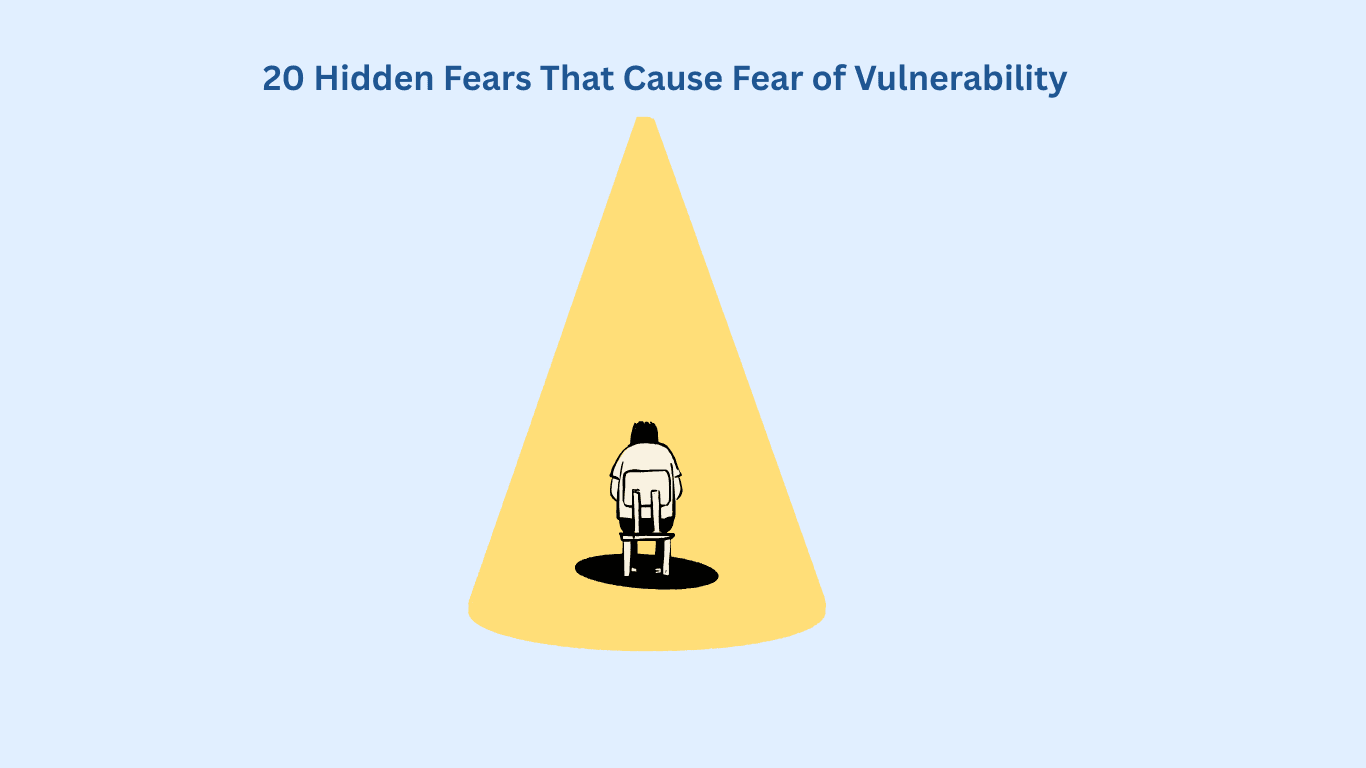
Vulnerability is the foundation of human connection. Without it, relationships remain superficial, intimacy stagnates, and personal growth halts.
Yet most people actively avoid vulnerability. They build walls, deflect with humor, change subjects, or maintain emotional distance.
And the reason to this fear of vulnerability? More fear.
To overcome the fear of vulnerability, you must first name what you are afraid of. This article examines 18 hidden fears that create and reinforce the fear of vulnerability.
1. Fear of being taken advantage of
You fear that if you share your weaknesses, someone will use them against you. This develops when people have exploited you before. Perhaps a friend used your secrets against you, or a partner used your insecurities to control you.
This fear of vulnerability shows up as hesitation. You hold back information, answer questions vaguely, and wait to see what others share first, telling yourself you are being careful.
What you need to understand is that not everyone is out to get you. Most people want connection.
So, be strategic. Share selectively with trustworthy people to build a support system. Withholding from everyone leaves you isolated and still vulnerable to the few who would harm you.
2. Fear of losing independence or autonomy
You fear that vulnerability means dependency. You have worked hard to be self-sufficient, and asking for help comes off like failure.
This fear of vulnerability shows up as refusing help. You do everything alone. You frame every request for support as a weakness. Furthermore, you pull away when people get too close, and you maintain distance so you can always leave.
The reality is that vulnerability enhances your independence. True independence includes the ability to share your struggles without surrendering your ability to make decisions.
3. Fear of being seen as “too much” or “not enough”
You constantly evaluate how others perceive you and fear that your authentic self is unacceptable.
This fear of vulnerability manifests as constant self-editing. You downplay your emotions, apologize for having needs, and present a curated version of yourself.
This fear puts you in a no-win situation. If you are “too much,” you overwhelm others. If you are “not enough,” you bore them. Both judgments depend entirely on who is watching. The people who are right for you will find your authentic self exactly what they want.
4. Fear of engulfment or losing one’s identity in a relationship
Some people fear that emotional closeness will eventually erase their individuality. They worry that relationships will require constant compromise, emotional availability, or sacrificing personal goals.
This fear of vulnerability shows up as keeping parts of your life separate. You maintain independent hobbies with strict boundaries, resist integrating your partner into your routines, and feel suffocated by basic relationship requests.
Healthy vulnerability requires maintaining your identity while allowing others into it. You can share your inner world without abandoning it.
5. Fear of being exposed as a fraud (imposter syndrome)
To you, opening up threatens to expose the “real” you.
You fear that vulnerability will reveal you as inadequate, less capable, successful, or confident than others think.
This shows up as deflecting praise, refusing to talk about accomplishments, attributing success to luck, and changing the subject when people express admiration.
Keep in mind: everyone experiences self-doubt. The people you admire experienced it too. Vulnerability about your insecurities does not expose you as a fraud. It exposes you as human.
6. Fear of being responsible for others’ emotions
You believe emotional openness creates obligations. You learned early that other people’s feelings are your responsibility. Maybe you were blamed for your parents’ moods, or you were told to make others feel better.
This fear shows up as careful management of bad news, softening difficult truths, worrying about upsetting people before worrying about your own needs, and avoiding anything that might create a negative response.
What you are missing is that someone reacting to your truth is their work. You are not responsible for their emotions. You are responsible for communicating honestly and kindly.
7. Fear of being unable to handle the outcome
Vulnerability always includes uncertainty. A person might respond with acceptance, rejection, misunderstanding, silence, or indifference.
This fear shows up as catastrophizing. You imagine worst-case scenarios, lay out conversations in your head, assume they end badly, and avoid initiating important conversations.
The problem is that this fear assumes your past coping ability is your current coping ability. That is false. You have grown, you have resources, and even if the worst happens, you will handle it.
8. Fear of being abandoned once “flaws” are revealed
You fear that people only value you for specific traits or achievements. If they see the parts that do not fit that image, they will leave.
This fear shows up as delaying disclosure. You present an idealized version of yourself, address faults only when they become impossible to hide, and feel immense pressure to maintain a perfect image.
Anyone who leaves because they see your true self was not staying for the right reasons. The point of vulnerability is to let people love the real you. If they leave, they were not a good fit.
9. Fear of being compared to others
You have been compared unfavorably throughout your life. Siblings, classmates, and partners were held up as superior. So, you learned that openness creates opportunities for judgment.
This fear shows up as avoiding personal details, deflecting conversations about achievements or failures, feeling competitive with others in your peer group, and monitoring how your experiences rank against others.
Comparison is a choice made by the observer. You cannot prevent someone from comparing you to others. But you can choose not to participate.
10. Fear of making the first move and being rejected
You fear initiating a connection and being turned down. Your brain associates approaching others with the possibility of that pain.
This fear shows up as waiting for others to approach you, sending ambiguous signals, avoiding stating your intentions clearly, and using humor to deflect from being serious about what you want.
Waiting to be approached does not prevent rejection. It only prevents you from controlling the timing. When you initiate, you face the possibility of no. When you wait, you face the certainty of no by default.
Making the first move gives you more information faster.
11. Fear of being trapped in emotional obligation
You fear that sharing creates a bond you cannot leave. You have felt obligated to stay in relationships because someone “needed” you. And vulnerability feels like signing a contract you cannot terminate.
This fear shows up as keeping relationships superficial, avoiding deep connections, and resenting others when they express emotional needs.
Vulnerability does not create obligation. It creates choice. You can share openly and still choose to leave. You can be honest and still set boundaries.
12. Fear of being mocked or ridiculed
You fear that sharing invites humiliation. You were mocked or ridiculed in the past, or your emotions were dismissed with humor.
This fear shows up as using self-deprecating humor to control the narrative. You share vulnerabilities only in a joking context, and you monitor the room for signs of laughter or dismissal.
People who mock genuine vulnerability are not safe. Their response says everything about them and nothing about you. So, surround yourself with people who do not mock and show your vulnerability.
13. Fear of being unable to protect oneself if hurt
You fear that vulnerability leaves you defenseless. You have been hurt and felt unable to respond. And now, you associate openness with danger.
This fear shows up as physical and emotional distance. You keep secrets, monitor others for signs of threat, and you develop hypervigilance in relationships.
Protection means developing the capacity to handle what happens. Vulnerability is a strength that has been tested and rebuilt. You can open up and still set boundaries.
14. Fear of being forgotten or dismissed after opening up
You fear that your vulnerability will be met with indifference. You shared something meaningful, and the response was nothing.
This fear of vulnerability shows up as testing people’s attention before sharing, using dramatic language to ensure you are heard, and feeling angry when people do not match your emotional intensity.
Some people cannot meet you where you are. Their dismissal is about their capacity, not your worth.
15. Fear of being perceived as unstable or dramatic
You fear that showing emotion leads to being pathologized. You have been labeled as overly emotional.
This fear of vulnerability shows up as careful emotional regulation. You moderate your tone, qualify every feeling with logic and explanation, avoid crying or visible distress, and present as composed at all times.
Strong emotion is human. The label “dramatic” is applied to people who express feelings that others are uncomfortable with. You are not unstable for having feelings.
In fact, you are unstable when you suppress them until they explode.
16. Fear of being blamed for the relationship’s problems
You fear that expressing your needs will lead to blame. You have been blamed for relationship issues.
This fear shows up as taking responsibility for everything. You apologize preemptively, frame your concerns as “maybe I am wrong,” and you accept fault to maintain peace.
Blame is a deflection. When someone blames you for their discomfort, they are avoiding responsibility for their emotions. You cannot prevent being blamed by staying silent. You can refuse to accept blame that is not yours.
17. Fear of being disrespected
You fear that sharing weakness invites disrespect. You have been dismissed, talked over, or invalidated. Now, you associate vulnerability with losing standing.
This fear shows up as projecting confidence at all times. You never admit confusion, frame everything as under control, reject offers of help, and maintain an image of total competence.
Respect is not earned by appearing invulnerable. It is earned by acting with integrity. Sharing honestly and handling the response with dignity commands more respect than hiding.
18. Fear of being silenced or invalidated after sharing
You fear that sharing invites erasure. You shared something important and were told you were wrong. Your experience was denied, and your feelings were invalidated.
This fear of vulnerability shows up as sharing only when you have evidence. You prepare counterarguments for your feelings, avoid speaking unless you can make an airtight case, and pre-defend your position.
No one can invalidate your lived experience. They can try, and they can deny. But your experience remains yours.
Conclusion
Every one of these fears is a protective mechanism. They developed to keep you safe from harm. And they are adaptations to real experiences.
The problem is that emotional protection comes with a cost.
The more you hide your thoughts, feelings, and needs, the harder it becomes to build trust, resolve conflict, and develop genuine intimacy. Relationships may continue, but they remain limited because important parts of each person stay hidden.
Recognizing these hidden fears is the first step toward changing them. When you understand what is driving your hesitation, you can respond intentionally instead of automatically retreating behind emotional walls.
Vulnerability does not require sharing everything with everyone. It requires choosing trustworthy people, communicating honestly, and accepting that meaningful relationships involve uncertainty.





Pingback: How to Overcome the Fear of Vulnerability? (9 Tips)
Pingback: How to Fix Avoidant Attachment: 15 Solid Action Plan
Pingback: How to Stop Overthinking In a Relationship? (12 Tips)