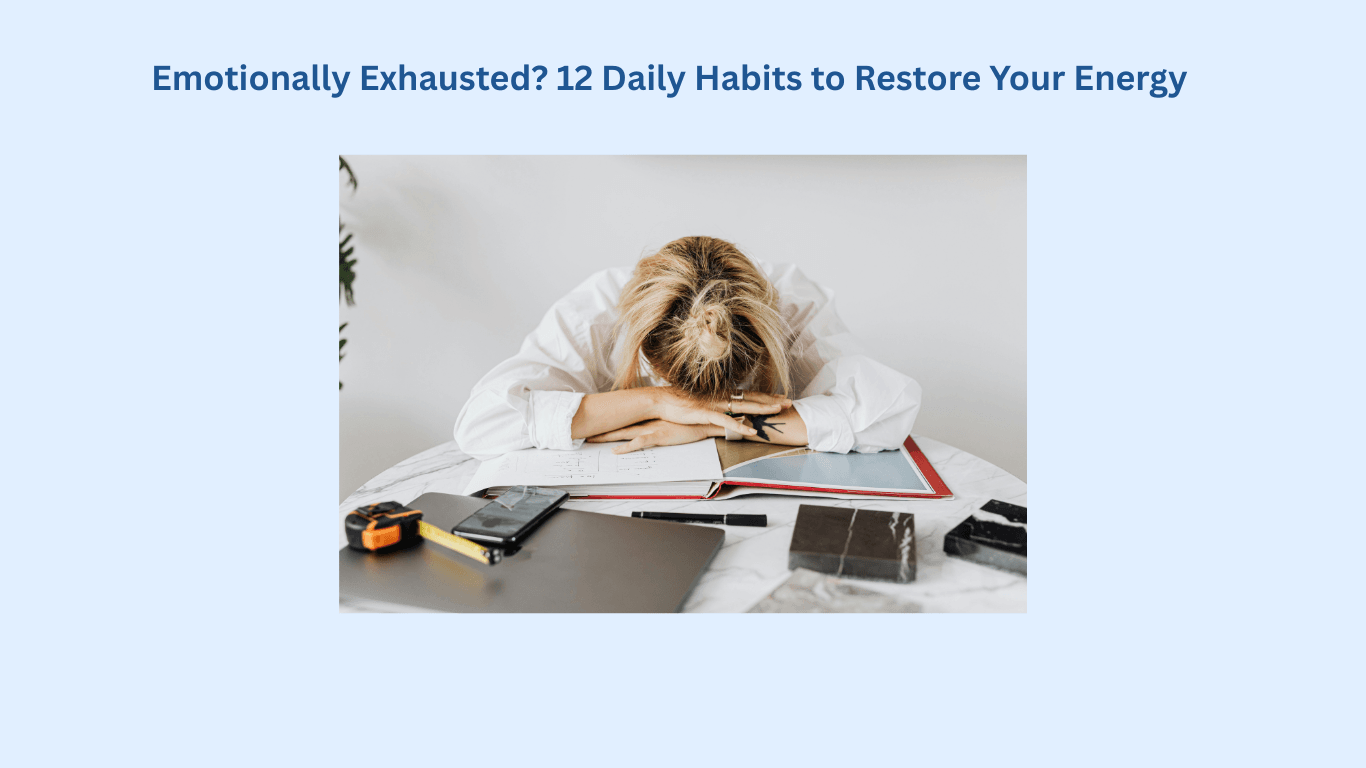
If you are emotionally exhausted, you may wake up tired, struggle to focus, lose patience quickly, or feel like even simple tasks require too much effort.
It affects every part of your life.
And the solution lies in daily habits that protect your emotional energy and restore balance. This article presents 12 actionable habits to implement immediately.
1. Stop offering emotional support to others all the time
Supporting family members, friends, and coworkers is an important part of healthy relationships. But constantly serving as everyone’s emotional support system can leave you drained.
Every time you provide emotional support, you expend energy. And without limits, that energy runs out.
To protect your well-being, set clear boundaries around emotional support. Designate specific times when you’re available to listen, and limit the duration of these conversations.
Communicate your availability clearly, and when someone seeks support outside those boundaries, gently redirect them to professional resources.
Most importantly, monitor your energy levels during support conversations, and end the interaction when you feel tired.
2. Refuse to carry someone else’s mood
People project their emotions onto others. You absorb moods from colleagues, family members, and friends without conscious awareness. This emotional contagion affects your state of mind.
Develop the skill of emotional differentiation. Pay attention when you are experiencing your emotions versus someone else’s.
When someone shares negative emotions, acknowledge them without adopting them. Use phrases like “I understand you are upset” without becoming upset yourself.
3. Don’t explain your feelings to people who won’t understand
Not everyone will validate your emotions. Some people dismiss your sentiments, criticize vulnerability, or immediately judge your experiences.
Trying to convince these people to understand you leads to disappointment and emotional exhaustion.
Identify which individuals in your life demonstrate understanding and which do not. Direct emotional conversations toward those with the capacity for comprehension. With others, maintain surface-level interactions.
When the urge to explain arises with an unsympathetic person, redirect the impulse. This habit reduces frustration and protects your emotional energy for meaningful connections.
Not everyone deserves access to your inner emotional world.
4. Stop predicting worst-case outcomes
Many emotionally exhausted are likely stuck in a loop of predicting worst-case outcomes. This catastrophic thinking drains mental and emotional energy.
Your brain expends resources imagining negative scenarios that rarely materialize, creating anxiety and reinforcing exhaustion.
So, interrupt this pattern. When you notice yourself predicting disasters, stop the thought and ask: What evidence supports this outcome? What evidence contradicts it?
Replace worst-case predictions with realistic assessments. Consider multiple possible outcomes rather than fixating on the negative.
Also, practice assuming positive intent in ambiguous situations. It reduces the cognitive load of preparing for threats that don’t exist.
5. Practice deep breathing for 5 minutes
Deep breathing signals your nervous system that you’re safe. It lowers stress and improves emotional regulation.
Set aside five minutes at a fixed time each day. Morning practice establishes a calm baseline. Midday offers a reset. Evening supports better sleep.
Consistency matters more than duration. Five minutes daily produces measurable reductions in stress markers. Use reminders until this habit becomes automatic.
6. Scheduled “worry time”
Many people spend their entire day worrying. Their minds jump from one concern to another without pause.
Instead of letting worry interrupt every moment, give it a designated space.
Choose a daily 15-20-minute block for worry. Same time each day.
During this period, actively worry about any concerns. Outside this block, postpone worries until the scheduled time.
Also, make sure you actively problem-solve rather than passively ruminating. Write down worries, assess their likelihood, and identify actionable steps. At the end of the time, close the worry notebook and move on.
7. Write down your worries instead of carrying them mentally
Trying to remember every concern keeps your mind busy, even when nothing can be done immediately.
Writing your worries on paper creates mental space.
The physical act of writing provides psychological release. Once written, worries feel more contained and manageable.
So, keep a dedicated notebook for worries. At the end of each day, write down all concerns. Use bullet points, be specific, and include both worst-case and realistic outcomes.
Review previous entries to identify patterns and resolve recurring concerns. For best results, combine this habit with your scheduled worry time.
8. Learn to accept that some things are outside your control
One of the biggest sources of emotional exhaustion is the desire to control everything.
You cannot control other people’s opinions, choices, unexpected events, the past, or every future outcome.
Identify what you can control (your actions, responses, and attitudes) and focus your energy there. Release attachment to outcomes beyond your influence.
This habit involves cognitive reframing. When faced with uncertainty, affirm: “I can control my actions and responses. I cannot control external results.”
Visualize accepting negative outcomes gracefully. This reduces fear of failure and conserves emotional energy for effective action.
9. Replace self-criticism with kinder self-talk
Many emotionally exhausted people speak to themselves more harshly than they would ever speak to another person. They focus on mistakes, ignore progress, and expect perfection.
Constant self-criticism increases stress and lowers confidence. So, practice speaking to yourself with honesty and kindness.
Notice critical internal dialogue, pause, and reframe it. Replace “I failed” with “I learned.” Replace “I should have” with “Next time.”
Develop specific self-compassion phrases like:
- I am doing my best with the resources I have
- Mistakes are part of growth
Use these phrases consistently to retrain default thinking habits. Evaluate your actions objectively without judgment, and recognize effort and intention, even when outcomes are imperfect.
10. Stop multitasking during personal time
Many people never truly disconnect. They answer emails during dinner, scroll through social media while watching TV, and mentally rehearse tomorrow’s work while sitting with family. This constant divided attention drains cognitive energy and blocks genuine mental recovery.
The solution is simple: during personal time, do one thing at a time. When you eat, just eat. When you walk, just walk. When you read, just read. When you’re with family, be fully with them.
Digital multitasking is especially harmful. Keep devices out of reach during meals and leisure, and set fixed times for checking messages rather than letting notifications run your downtime.
Deep, single-tasked leisure restores the mind in ways fragmented attention never can. In the end, it’s not about how much free time you have. It’s about how fully you inhabit it.
11. Celebrate small accomplishments each day
Waiting for major achievements before feeling proud creates constant dissatisfaction, and reinforces inadequacy and exhaustion.
At the end of each day, identify three accomplishments. They can be small:
- Completing a difficult task
- Going for a walk
- Drinking enough water
- Finishing household chores
- Taking a break when needed
- Keeping a promise to yourself
Celebrating these small wins increases motivation and turns your attention toward growth instead of constant pressure.
12. Listen to nature sounds
Constant exposure to traffic, conversation, and digital noise keeps your nervous system on high alert.
In contrast, nature sounds such as birdsong, flowing water, and wind through leaves, activate your body’s relaxation response. These sounds have been shown to lower cortisol levels and reduce heart rate.
To benefit, incorporate nature sounds into your daily routine. Even just five minutes of listening can provide measurable stress reduction. When natural settings aren’t accessible, use high-quality recordings to bring the outdoors in.
Timing matters too.
Morning exposure to nature sounds sets a calm, centered tone for the day. An afternoon listening break offers a much-needed reset, while evening listening helps prepare your mind and body for restful sleep.
Conclusion
Being emotionally exhausted is a sign that you have been carrying too much for too long.
Emotional exhaustion builds slowly, layer by layer, as stress accumulates and your inner resources run dry. And That’s why recovery demands intentional, daily actions that both protect your remaining energy and actively restore what’s been lost.
That’s why recovery demands intentional, daily actions that both protect your remaining energy and actively restore what’s been lost.
The 12 habits outlined here helps you start. But you don’t need to tackle them all at once.
Start small: choose just three habits to focus on this week. Practice them consistently, track how they affect your mood and energy, and once they feel natural, gradually introduce more.
Above all, be patient with yourself. Healing and restoration takes time. Every conscious choice you make, no matter how small, is a step back toward yourself and away from feeling emotionally exhausted.





Pingback: How Can You Tell If Someone Doesn't Like You Romantically? (14 Obvious Signs)