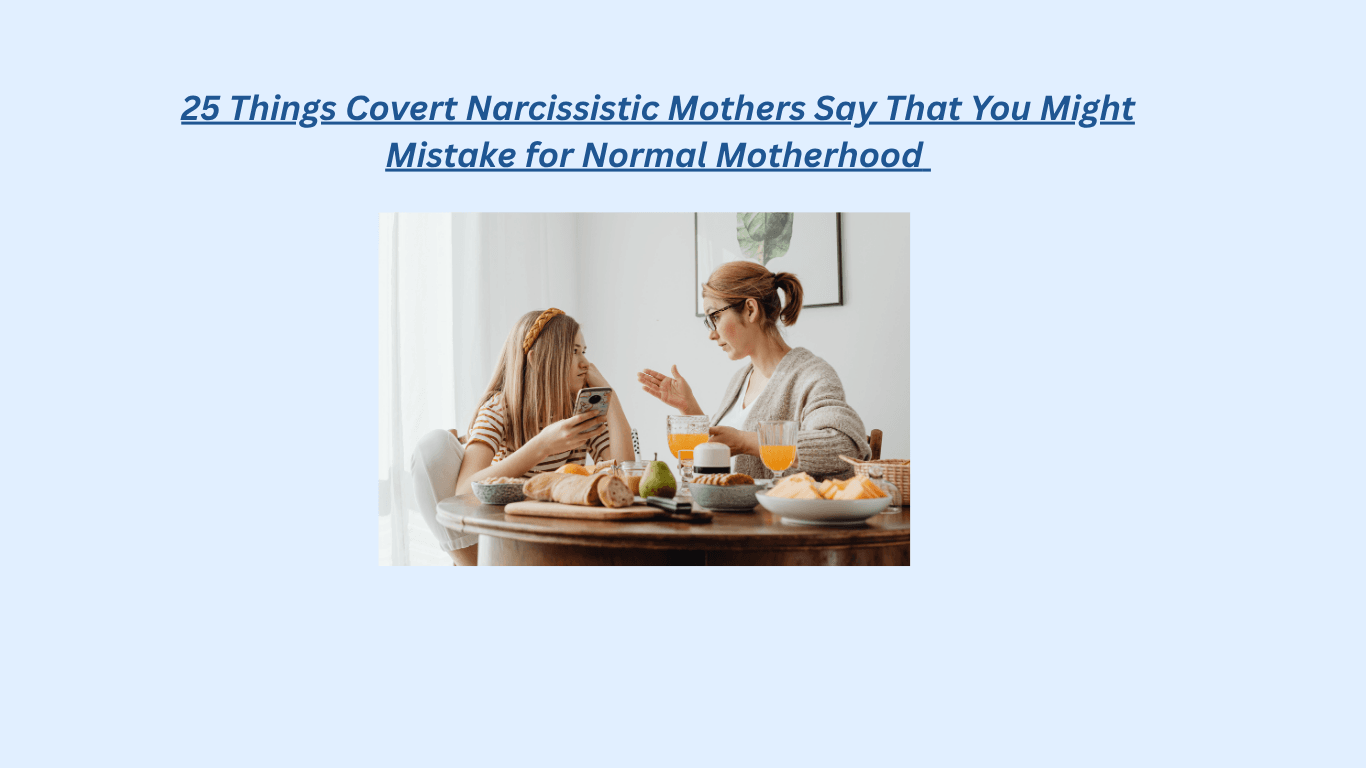
The reason things covert narcissistic mothers say are so hard to spot is that they mimic normal maternal concern.
Healthy mothers could say difficult things when they are stressed, worried, disappointed, or afraid of losing connection with their children.
But a covert narcissistic mother may use statements that sound like normal motherhood to create guilt, dismiss boundaries, control decisions, demand emotional loyalty, or make her child responsible for her feelings.
And because these phrases mimic caring motherhood, they can be confusing and hard to recognize.
Below are 25 things covert narcissistic mothers say that you might mistake for normal motherhood.
1. I only want what’s best for you
She may say this when you reject her advice, make a decision she dislikes, or choose something different from what she recommended.
The statement reframes her control as generosity.
It can shift the discussion from whether her advice is appropriate to whether you trust her intentions. You may feel guilty for disagreeing because she has presented herself as someone acting for your benefit.
2. I’m only saying this because I love you
Usually, she says this before or after criticizing your appearance, relationships, career, parenting, personality, or decisions.
If you defend yourself, you may be accused of rejecting her love rather than objecting to how you were treated. The phrase turns cruelty into a gift you are obligated to accept.
To tell whether it’s love or narcissism, notice whether she expresses concern without humiliating, controlling, or undermining you.
3. I was only trying to make you better
She says this when you confront her about something she said or did that hurt you.
Her statement erases your reaction and replaces it with her intention. And your pain becomes irrelevant because she meant well.
4. I’m your mother. That’s what mothers do
She says this when you question her behavior. It appeals to a universal standard that doesn’t exist. It normalizes intrusion, criticism, and control as maternal instinct.
5. I’m hard on you because I know you’re capable of more
She says this whenever you achieve something, but instead of celebrating the achievement, she focuses to what you could have done better.
This allows her to diminish your work while positioning herself as the person who support you and sees your potential. It can also function as a way of keeping you dependent on her approval and chasing her validation.
6. Nobody else is going to be honest with you like I am
She says this when you start trusting other people’s opinions. It isolates you and positions her as the only truthful person in your life and everyone else as either naive or deceptive.
7. I know you better than you know yourself
She says this when you express a feeling, preference, or decision she disagrees with. It teaches you to doubt your internal experience, leaving you dependent on her.
8. I know you’re an adult, but you’re still my child
She says this when you try to set a boundary or make an independent decision. It is a polite way of saying she retains authority over you permanently.
9. I raised you to have a mind of your own, but apparently you only use it to disagree with me
She says this when you disagree with her. It claims she wanted an independent thinker while punishing you for being one.
The message is that your mind is acceptable only when it agrees with hers.
10. I did my best
This is one of the things covert narcissistic mothers say when you raise a grievance about your childhood or your current relationship.
Instead of discussing what happened, the focus becomes her intentions and limitations.
As a result, It demands sympathy instead of accountability. She ends the conversation before she has to acknowledge your experience.
11. I sacrificed my whole life for my children
She says this when you are not giving her enough attention, gratitude, or compliance. It converts normal parental responsibility into a debt you can never repay.
12. After everything I’ve done for you…
She says this after you refuse a request, set a boundary, or make a decision she dislikes.
The sentence never finishes because it doesn’t need to because it reminds you of everything she believes you owe her.
13. I don’t ask for much
She says this before asking for something excessive, like loyalty, information, access to your children, or control over your plans. It minimizes the demand and increases your guilt for refusing it.
14. If you really loved me, you wouldn’t have to be asked
She says this when she expects you to take responsibility for her needs. It punishes you for not managing her emotions before she has to express them.
15. No one will ever love you as I do
She may say this when you become more independent or when another relationship becomes important to you.
The statement can create fear around separation. It suggests that leaving her emotional orbit means losing your most important source of love.
16. You don’t need to tell me everything, but I thought we were closer than that
She says this when you keep something private. It sounds less demanding than “You have to tell me,” but it can create the same pressure through guilt.
17. Family shouldn’t keep secrets from each other
She says this when you don’t share information she wants. It can confuse the difference between secrecy and privacy. And it teaches you that family membership requires total transparency, but only in one direction.
18. I don’t understand why you need boundaries with your mother
She says this when you establish a limit. The word “mother” is used to make the boundary seem unnatural or disrespectful.
As a result, it forces you to justify something that requires no justification.
19. Family comes first
She says this when you prioritize your spouse, children, career, friends, or personal responsibilities. It sounds like a value but it operates as a demand.
Family means her, and first means always.
20. Your father/brother/sister agrees with me
She says this when she wants to win an argument. It invents or exaggerates allies. Even if the claim is true, it is used to pressure you, not to inform you.
21. Why can’t you be more like [sibling/cousin/friend]?
She says this when you do something she dislikes or when someone else performs compliance better than you. It creates competition and resentment. It also communicates that acceptance depends on becoming more like someone else.
22. I’m glad you’re successful, but don’t forget where you came from
She says this when your success doesn’t translate into gratitude, attention, or control for her. The message is that your achievements should belong to her.
23. You’ll understand when you have children
She says this when criticize her parenting or question something she did when raising you. It can dismiss your current perspective by suggesting that you lack the experience necessary to judge her.
24. One day, you’ll regret treating your mother this way
She says this when you enforce a consequence. It is a threat disguised as wisdom, designed to provoke fear about future regret.
By encouraging you to imagine losing her, she redirects the focus from the consequence itself to the possibility that you will one day blame yourself for enforcing it.
25. I guess I’m just a terrible mother
She says this when you complain about her behavior. The conversation ends with you apologizing for something she did.
Conclusion
The words alone don’t prove narcissism.
What matters is the pattern, especially what happens when you disagree. Can she accept your decisions, respect your privacy, apologize without making you comfort her, or hear criticism without playing the victim?
A covert narcissistic mother becomes clearer when the same statements repeatedly appear whenever you assert yourself.
So, keep in mind: one hurtful comment doesn’t define a person, but a consistent pattern of guilt, manipulation, victimhood, boundary violations, and refusal to take responsibility tells you much more.